
Why Most IELTS Students Plateau After Band 6 (And How to Finally Reach Band 7+)
Why Most IELTS Students Plateau After Band 6 (And How to Finally Reach Band 7+)
For many IELTS students, Band 6 becomes a frustrating wall.
No matter how much they study…
No matter how many mock tests they complete…
No matter how many hours they spend watching IELTS videos…
their score refuses to improve.
This is one of the most common problems in IELTS preparation.
And the truth is:
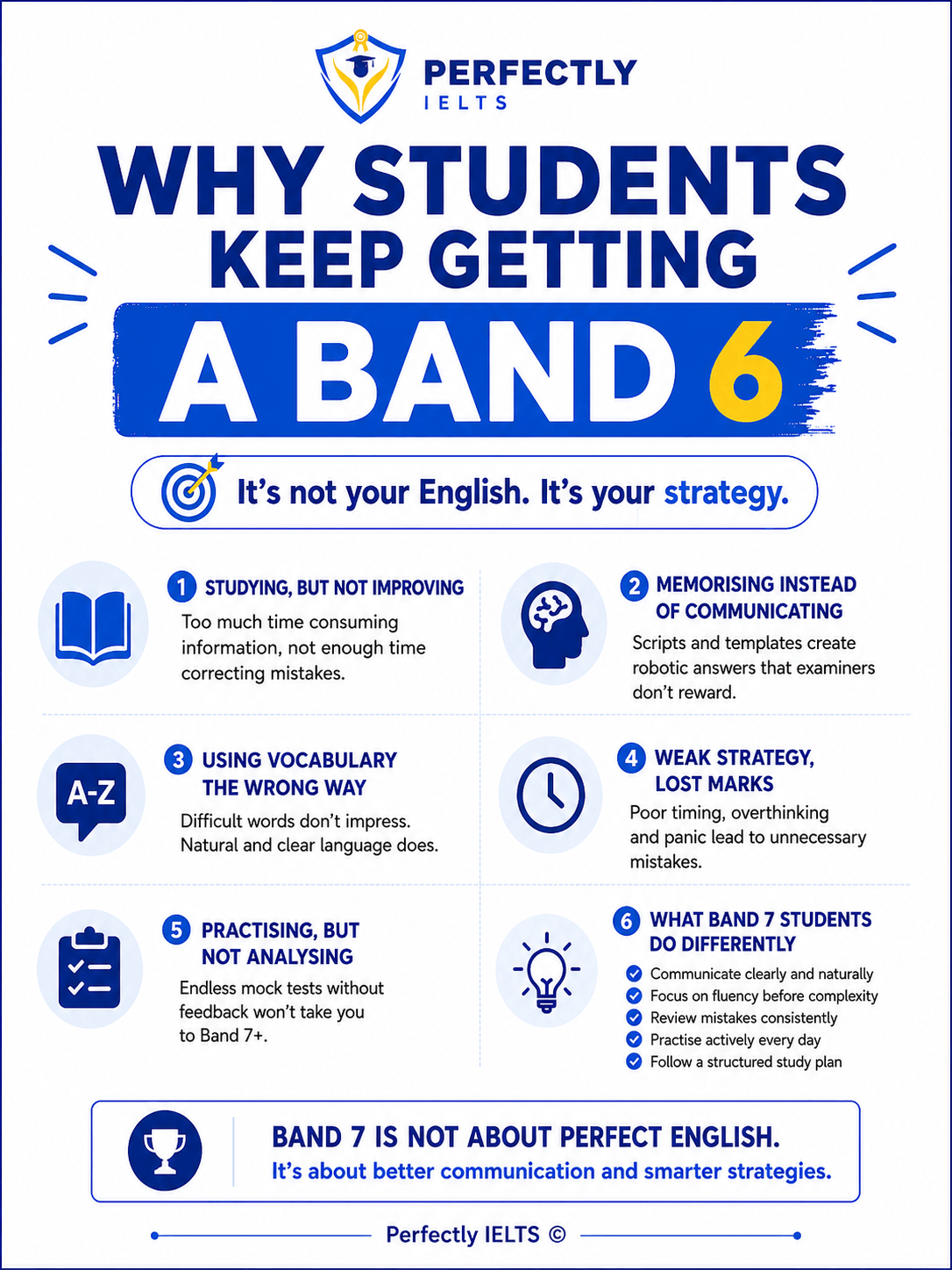
Most students are not failing because their English is “bad.”
They are failing because they are using the wrong preparation strategy.
If you feel stuck at Band 6 or 6.5, this article will explain:
why students plateau
the hidden mistakes lowering scores
what Band 7 students do differently
and how to improve your IELTS score faster
If you want a step-by-step IELTS study system designed to help students break past Band 6 faster, you can join our FREE 5-Day IELTS Course here:
Why Band 6 Is So Common in IELTS
Band 6 is actually a very normal score.
At this level, students can usually:
communicate basic ideas
understand most conversations
write understandable sentences
and answer IELTS questions reasonably well
But Band 7 requires something different.
Examiners expect:
clearer communication
better organisation
more natural vocabulary
stronger fluency
and fewer repeated mistakes
This is where many students struggle.
Because improving from Band 5 to Band 6 is mostly about learning more English.
But improving from Band 6 to Band 7 is often about improving how efficiently you use the English you already know.
The Biggest Reason Students Plateau
Most IELTS students spend too much time:
consuming information
memorising techniques
and collecting study materials
But not enough time:
correcting mistakes
improving communication
or training under realistic conditions
This creates the illusion of progress.
Students feel productive because they are studying constantly.
But their actual IELTS performance stays almost the same.
This is why some students study for 6 months…
…and still receive Band 6 again.
The Hidden Difference Between Band 6 and Band 7 Students
Many students think Band 7 students use:
perfect grammar
advanced vocabulary
or extremely academic English
But that is rarely the main difference.
Band 7 students usually communicate:
more naturally
more clearly
and more confidently
For example:
Band 6 Style Answer
“Technology is very useful nowadays and people use it every day.”
More Band 7 Style Answer
“Technology has become an essential part of daily life, especially for communication, work, and education.”
The second answer is not extremely advanced.
But it sounds:
more specific
more natural
and more fluent
That is what examiners reward.
Why Memorising IELTS Answers Usually Backfires
A huge number of students try to memorise:
speaking scripts
writing templates
introductions
“Band 9 vocabulary”
or model answers
This feels safe.
But it often creates robotic English.
Examiners can usually recognise memorised responses very quickly because they sound:
unnatural
inflexible
over-rehearsed
and disconnected from the question
The IELTS exam is designed to test real communication ability.
Not memorisation.
Students who rely heavily on scripts often panic when the question changes slightly.
That’s why flexible communication is far more valuable than perfect memorised sentences.
The Vocabulary Mistake That Keeps Students Stuck
One of the biggest IELTS myths is this:
“To get Band 7, I need extremely advanced vocabulary.”
So students start memorising long lists of difficult words.
But then they try to force those words into every answer.
This creates awkward English.
For example:
Unnatural IELTS English
“The proliferation of technological advancements has ameliorated societal interaction.”
Natural IELTS English
“Technology has made communication much easier.”
The second version is:
clearer
more natural
easier to understand
and less likely to contain grammar mistakes
IELTS examiners reward effective communication — not complicated wording.
Why Students Struggle With IELTS Reading
Reading is one of the biggest problem areas for Band 6 students.
Most students lose marks because of:
poor time management
weak skimming skills
misreading keywords
panic under pressure
and overthinking answers
Many students read every word slowly.
If you struggle specifically with comprehension and timing in the IELTS Reading test, it’s worth looking at why many students repeatedly get stuck at Band 6 in this section. This is explained in detail here: Why You Keep Getting Band 6 in IELTS Reading (And How to Finally Reach Band 7+).
But IELTS Reading is not designed for slow reading.
Strong students learn how to:
skim quickly
scan for keywords
predict information
and locate answers efficiently
This is a strategy skill — not just an English skill.
The Real Problem With Endless Mock Tests
Practice tests are useful.
But many students become trapped in “practice mode.”
They complete:
test after test
video after video
worksheet after worksheet
without analysing why they keep losing marks.
This is one of the biggest reasons students plateau.
Sometimes students improve more from:
reviewing one speaking recording carefully
correcting one writing task properly
or analysing one reading passage deeply
than from doing five extra mock exams.
Quality feedback matters more than endless repetition.
One of the biggest reasons students plateau in Writing is not grammar, but weak idea generation under pressure. If you often run out of ideas in essays, you should read this guide on how to quickly generate strong arguments: IELTS Writing Task 2 Brainstorming Guide (2026): How to Generate Band 7+ Ideas Fast for High-Scoring Essays.
How to Actually Improve Your IELTS Score Faster
Focus on Repeated Mistakes
Most students repeat the same problems:
grammar errors
pronunciation issues
weak sentence structure
poor idea development
or timing mistakes
Tracking repeated errors helps students improve much faster.
The goal is not perfection.
The goal is reducing repeated weaknesses.
Build Fluency Before Complexity
Many students try to sound “advanced” too early.
But fluency matters more than sounding academic.
A simple answer spoken confidently is usually stronger than a complicated answer filled with mistakes.
Focus on:
smooth communication
clear explanations
and natural phrasing
first.
Complexity should come later.
Practise Producing English Every Day
Passive learning alone is not enough.
Students improve faster when they actively:
speak
write
paraphrase
summarise
and explain ideas in English
IELTS is a performance exam.
You must train your ability to produce language under pressure.
Learn Vocabulary Through Context
Instead of memorising isolated words, learn vocabulary inside phrases.
For example:
Instead of learning:
“beneficial”
learn:
highly beneficial
beneficial for students
economically beneficial
This helps vocabulary become natural and usable.
Improve Confidence Alongside English
Many students know more English than they realise.
But exam stress causes them to:
freeze
hesitate
overthink
or panic
Confidence directly affects:
fluency
pronunciation
speaking speed
and communication quality
Good preparation improves both skill and confidence together.
What Band 7 Students Usually Do Differently
Students who break past Band 6 often:
review mistakes consistently
focus on communication over memorisation
practise actively instead of passively
build fluency gradually
and follow structured study plans
They usually do fewer random activities…
…but with much more focus and consistency.
That is the real difference.
Final Thoughts
Most IELTS students do not plateau because they are incapable of improving.
They plateau because they spend too much time:
memorising
consuming information
and practising inefficiently
Band 7 is not about perfect English.
It is about:
clearer communication
better fluency
natural vocabulary
stronger strategy
and fewer repeated mistakes
Small improvements done consistently over time can completely change your IELTS score.
If you want a complete roadmap that connects all four IELTS skills into one structured system, this guide brings everything together in a step-by-step format: The Ultimate IELTS Preparation Guide (2026): How to Get Band 7+ in All 4 Sections.
If you want a structured IELTS study system designed to help students improve faster and avoid the most common mistakes, you can join our FREE 5-Day IELTS Course here:

© Perfectly IELTS - Privacy Policy & Terms and Conditions