
Why You Keep Getting Band 6 in IELTS Reading (And How to Finally Reach Band 7+)
Why You Keep Getting Band 6 in IELTS Reading (And How to Finally Reach Band 7+)
Many IELTS students feel frustrated with Reading.
No matter how much practice they do, their score stays around:
Band 5.5
Band 6
or sometimes 6.5
They complete practice tests every week.
They study vocabulary.
They watch YouTube videos.
But when exam day comes, they still:
run out of time
panic during Passage 3
misread questions
and lose easy marks
The truth is:
Most students are not failing IELTS Reading because their English is bad.
They’re failing because they’re using the wrong strategy.
If you want a step-by-step IELTS system designed to help students reach Band 7+, you can join our FREE 5-Day IELTS Course here:
👉 Start the free 5-day IELTS course
Why IELTS Reading Feels So Difficult
The IELTS Reading test is designed to create pressure.
You have:
40 questions
3 long passages
only 60 minutes
That means you must:
read quickly
understand accurately
and manage time carefully
At the same time.
This is why many students feel overwhelmed — especially in Passage 3, where the language becomes more academic and complex.
But here’s what many Band 7+ students eventually realise:
IELTS Reading is not only an English test.
It’s also a strategy test.
The Biggest IELTS Reading Mistake
Most students approach IELTS Reading like a school exam.
They try to:
understand every word
read every sentence carefully
translate difficult vocabulary
and memorise large vocabulary lists
This creates two huge problems:
You read too slowly
You become mentally exhausted
Strong IELTS students do not read every passage word-for-word.
Instead, they:
scan for information
identify keywords
understand paragraph structure
and locate answers strategically
This saves huge amounts of time.
Why You Keep Running Out of Time
One of the most common IELTS Reading problems is poor time management.
Usually the exam looks like this:
Passage 1
You feel confident.
Passage 2
You start slowing down.
Passage 3
You panic and rush everything.
Suddenly:
concentration drops
mistakes increase
confidence disappears
The problem is often not your English level.
It’s your pacing strategy.
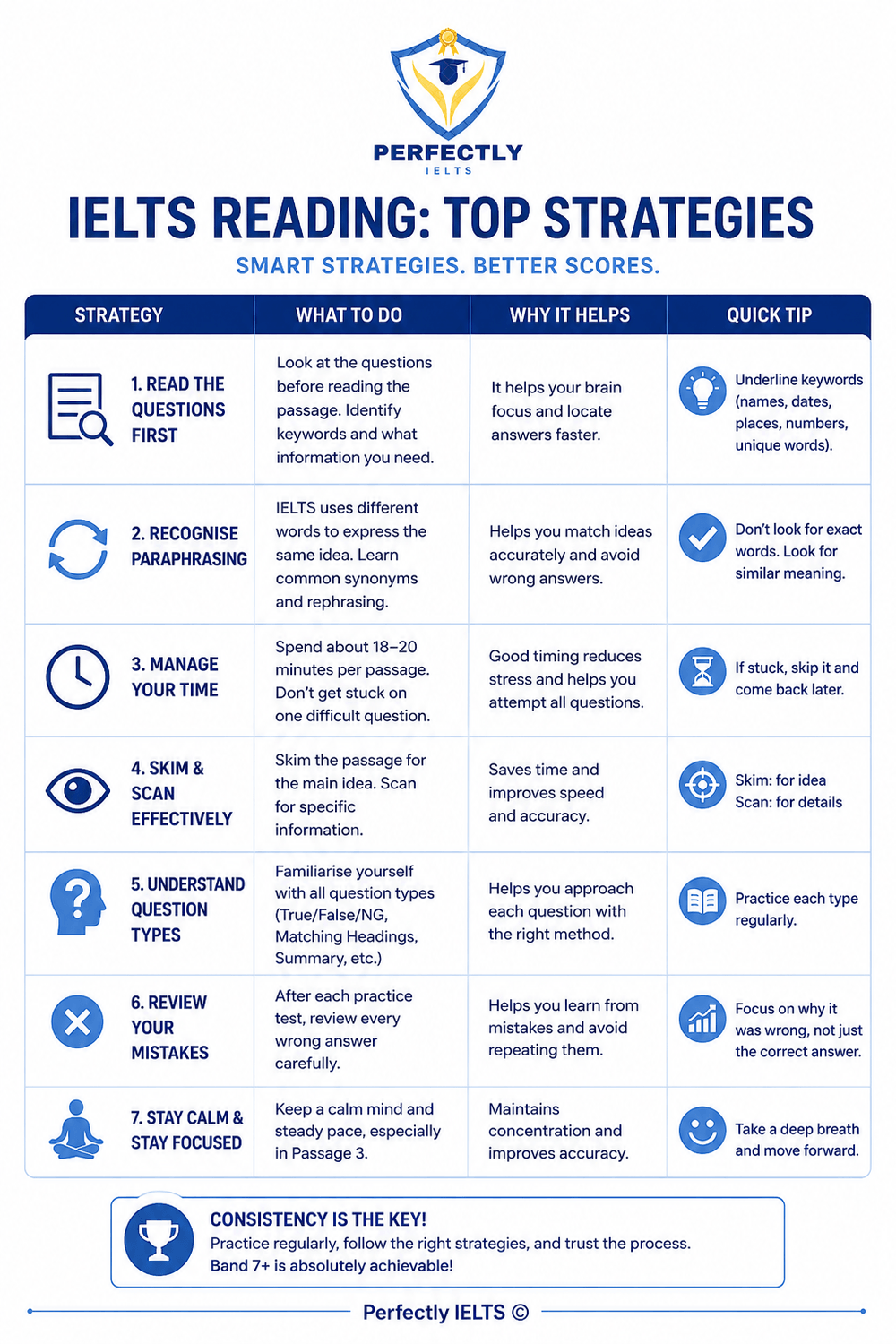
How Band 7+ Students Approach IELTS Reading
High-scoring students usually follow a more structured method.
Step 1 — Read the Questions First
Before reading the passage fully:
look at the questions
identify keywords
understand what information you need
This trains your brain to search actively instead of reading passively.
For example, notice:
names
dates
locations
unusual terms
numbers
opinions
These often help you locate answers faster.
Step 2 — Learn to Recognise Paraphrasing
This is one of the most important IELTS Reading skills.
IELTS rarely repeats the exact same words from the questions.
Instead, the exam uses paraphrasing.
For example:
“important” → “significant”
“problem” → “issue”
“rise” → “increase”
“dangerous” → “harmful”
Students who only search for exact words often miss correct answers completely.
This is why vocabulary recognition matters more than memorising random advanced words.
Step 3 — Stop Spending Too Long on Difficult Questions
Many students destroy their timing by becoming obsessed with one difficult question.
Band 7+ students understand something important:
Not every question deserves 5 minutes of your time.
Sometimes the best strategy is:
skip it temporarily
continue moving
return later with a clearer mind
This prevents panic and protects your overall score.
The Most Difficult IELTS Reading Question Types
Certain question types consistently cause problems.
True / False / Not Given
This section confuses many students.
The key difference is:
TRUE
The information agrees with the text.
FALSE
The text directly contradicts the statement.
NOT GIVEN
The information is missing completely.
Many students lose marks because they assume:
“Maybe it’s probably true.”
IELTS does not reward guessing.
The answer must be clearly supported.
Matching Headings
This tests:
understanding of main ideas
paragraph purpose
overall structure
A common mistake is focusing on small details instead of the paragraph’s central meaning.
Ask yourself:
“What is this paragraph mainly about?”
not:
“What small fact did I notice?”
Sentence Completion
Students often lose marks because they:
ignore word limits
copy incorrect grammar
choose answers too quickly
Always check:
spelling
grammar fit
word count instructions
One small mistake can lose the mark completely.
The IELTS Reading Technique That Improves Scores Faster
Most students think improvement comes from:
doing endless practice tests
But real improvement usually comes from:
reviewing mistakes carefully
After every test, ask:
Why was this answer wrong?
Did I misunderstand the question?
Did I miss a synonym?
Was it a timing problem?
Did I panic?
This type of review builds awareness.
And awareness improves scores much faster.
How to Improve IELTS Reading at Home
You do not need expensive courses to improve.
Some of the best habits are simple.
1. Read English Every Day
Good materials include:
BBC News
National Geographic
blogs
science articles
opinion pieces
This helps improve:
reading speed
vocabulary recognition
comprehension
focus
2. Practice Under Real Exam Conditions
Do not always practice comfortably.
Use:
timers
full passages
quiet environments
This trains your brain for exam pressure.
3. Build Scanning and Skimming Skills
These are essential IELTS Reading skills.
Skimming
Reading quickly to understand the general idea.
Scanning
Searching for specific information rapidly.
Strong readers constantly switch between both.
Why Vocabulary Lists Often Don’t Work
Many students spend months memorising difficult IELTS vocabulary.
But in the exam:
they forget words
cannot use them naturally
or still struggle with timing
Vocabulary matters.
But strategy matters just as much.
A student with:
solid scanning skills
good timing
and strong question awareness
can outperform someone with better English but poor technique.
What Actually Helps You Reach Band 7 in IELTS Reading
Band 7+ students usually:
stay calm under pressure
manage time effectively
recognise paraphrasing
understand question patterns
and avoid overthinking
Most importantly:
they practice consistently over time.
Not perfectly.
Consistently.
Final Thoughts
If your IELTS Reading score feels stuck right now, do not assume you are “bad at English.”
In many cases, the real issue is:
poor timing
weak strategy
ineffective review habits
or panic under pressure
Once you improve:
scanning
skimming
keyword recognition
and time management
your score can improve surprisingly quickly.
IELTS Reading is a skill.
And skills improve with the right system and consistent practice.
If you want a step-by-step IELTS study system designed to help students reach Band 7+, you can join our FREE 5-Day IELTS Course here:

© Perfectly IELTS - Privacy Policy & Terms and Conditions