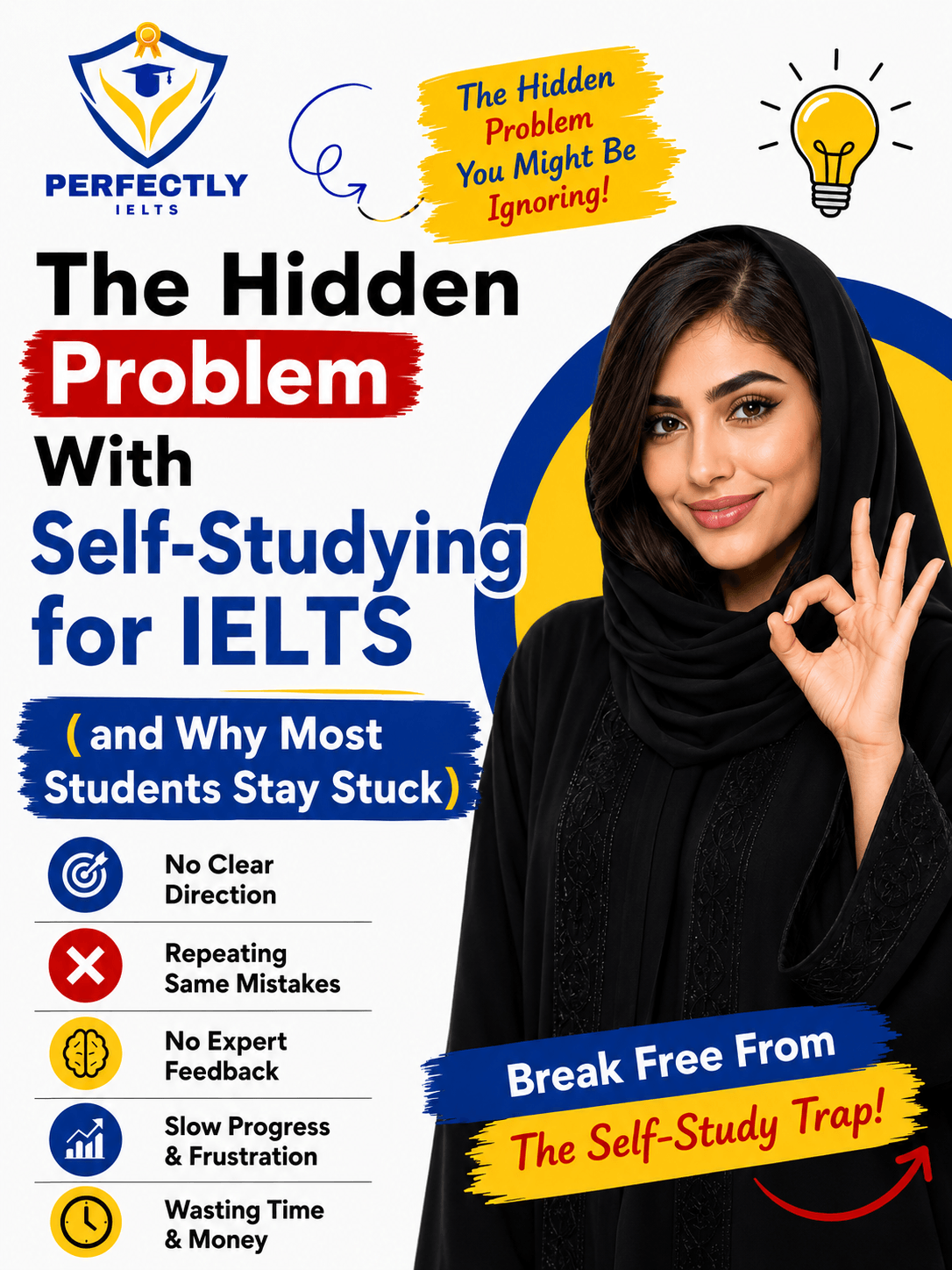
The Hidden Problem With Self-Studying for IELTS (and Why Most Students Stay Stuck)
The Hidden Problem With Self-Studying for IELTS (and Why Most Students Stay Stuck)
Thousands of IELTS candidates spend months preparing on their own.
They watch videos.
They complete endless practice tests.
They memorise vocabulary lists and essay templates.
And yet, when exam day arrives… their score barely moves.
This is one of the most common (and most frustrating) patterns in IELTS preparation.
Not because students aren’t working hard — but because they’re often working without the one thing that actually drives improvement: accurate, personalised feedback from an experienced IELTS examiner or teacher.
Why Self-Study Alone Often Stops Working
Self-study can absolutely help you build familiarity with the IELTS test.
But at a certain point, most students hit the same wall:
They don’t know what they’re doing wrong.
And worse — they don’t even realise they’re repeating the same mistakes.
This is especially true in:
Writing Task 1 and Task 2
Speaking fluency and coherence
Grammar accuracy
Task response and relevance
Without structured feedback, students often continue practising the same weaknesses for weeks or even months.
Not because they’re lazy — but because they can’t see the problem clearly.
The Illusion of Progress
One of the biggest challenges in IELTS preparation is that progress can feel real even when it isn’t happening.
Many students spend hours each week:
watching IELTS YouTube lessons
reading Band 9 sample answers
memorising phrases and vocabulary
doing random mock tests
It feels productive.
But without expert correction, there is no confirmation that improvements are actually aligned with IELTS marking criteria.
This is where students often plateau — especially around Band 5.5 to Band 6.5.
Why Students Misjudge Their IELTS Level
It’s extremely common for students to overestimate (or underestimate) their ability.
For example:
A student may believe they are Band 7, but are consistently scoring Band 6
Another student may think they are weak, but are actually closer to Band 6.5 with fixable issues
The IELTS system is not just about “good English.”
It is assessed using specific criteria:
Task Achievement / Task Response
Coherence and Cohesion
Lexical Resource
Grammatical Range and Accuracy
Fluency and Pronunciation (Speaking)
Most self-study learners focus heavily on vocabulary and grammar — while unintentionally neglecting structure, clarity, and response quality.
Why Writing Is Almost Impossible to Improve Alone
Writing is the hardest skill to self-correct.
A student may finish an essay and think:
“This looks fine.”
But an experienced IELTS teacher will immediately notice issues such as:
unclear argument development
weak paragraph structure
overused or inaccurate vocabulary
inconsistent grammar patterns
ideas that are not fully relevant to the question
The problem is not effort — it’s visibility.
You can’t reliably judge your own writing against official band descriptors without training.
This is why many students stay stuck at the same writing score for months, even when they are practising regularly.
Speaking: Where Self-Practice Fails Most Students
Speaking practice alone often creates a false sense of improvement.
Students may talk every day — but without correction, they often develop habits like:
memorised or unnatural answers
frequent hesitation and self-correction
limited fluency under pressure
pronunciation issues that go unnoticed
repetitive vocabulary patterns
Because no one is actively correcting them in real time, these issues become normalised.
And in the real exam, examiners immediately notice them.
Why Mock Tests Matter More Than Most Students Realise
A proper IELTS mock test is not just practice.
It is a diagnostic tool.
It should clearly show:
your current estimated band score
your strongest and weakest criteria
repeated mistakes affecting your score
your readiness for the real exam
and what is preventing you from reaching the next band level
Without this type of evaluation, most students are preparing blindly — hoping their score will improve without knowing what actually needs to change.
The Importance of Human Feedback in IELTS Preparation
This is where many learners are now turning back to something essential: experienced human IELTS feedback.
AI tools and automated scoring systems can be helpful for basic practice, but they have clear limitations.
AI can sometimes:
misjudge coherence and task response
miss subtle grammar patterns
provide inconsistent scoring across similar answers
fail to understand examiner expectations in full context
Most importantly, AI cannot replicate the judgement of a trained IELTS examiner who understands how marking works in real exam conditions.
A human IELTS teacher with 10+ years of experience can:
identify why marks are being lost (not just what is wrong)
apply real IELTS band descriptors accurately
evaluate writing and speaking with examiner-level insight
provide targeted strategies for improvement
recognise patterns that AI systems often miss
This level of feedback is what actually helps students move from Band 6 → 7, or Band 7 → 8.
Full IELTS Mock Test (with Expert Human Feedback)
If you want a clear and accurate understanding of your current IELTS level, our Full IELTS Mock Test is designed to replicate real exam conditions and provide detailed, human-led evaluation.
👉 Buy Now
What’s Included:
✍️ Full Writing Evaluation (Task 1 + Task 2)
Your writing is assessed individually for both tasks, including:
Task 1 report/letter analysis
Task 2 essay evaluation
Band score estimation for each task
Detailed corrections and feedback
Grammar, vocabulary, and structure review
Clear explanation of why marks were lost
This is not automated feedback — it is structured, examiner-style evaluation based on IELTS band descriptors.
🗣️ LIVE Speaking Mock Test
A realistic IELTS speaking simulation with direct interaction.
Includes:
Part 1, Part 2, and Part 3 questions
Fluency and coherence evaluation
Pronunciation feedback
Vocabulary usage analysis
Examiner-style scoring estimation
This helps you experience real test pressure before your actual exam.
📊 Professional IELTS Assessment Report
After completion, you receive a full breakdown including:
Estimated overall band score
Individual skill performance analysis
Key weaknesses affecting your score
Strengths you can build on
Clear improvement roadmap
What You Gain From This Mock Test
✔ A realistic understanding of your true IELTS level
✔ Clear identification of score-limiting mistakes
✔ Detailed Writing Task 1 & Task 2 feedback
✔ Speaking fluency and pronunciation analysis
✔ Examiner-style scoring and evaluation
✔ Actionable steps to improve efficiently before your exam
Why Students Use This Before Their Exam
Most students book a full mock test when they realise:
they keep getting the same score repeatedly
they are unsure what is holding them back
their self-study progress has plateaued
they want a final realistic assessment before test day
This mock test is designed to remove uncertainty and replace it with clarity.
How It Works
1. Secure Your Booking
👉 Sign Up
2. Receive Writing Instructions
You will be guided on how to complete Writing Task 1 and Task 2 under exam conditions.
3. Complete Your Live Speaking Test
Attend your scheduled speaking session with an IELTS examiner-style interview.
4. Receive Detailed Feedback
You will receive structured, human-written feedback including band estimates and corrections.
5. Improve Your Exam Strategy
Use your feedback to focus only on what will actually raise your score.
Additional IELTS Support Options
🗣️ Full Speaking-Only Mock Test
A dedicated speaking assessment with detailed fluency, grammar, and pronunciation feedback.
👉 Buy Now
📘 IELTS Practice Test Bundles
Independent practice materials for continued self-study:
👉 Buy Now
Who This Is For
This mock test is ideal for:
students preparing for their IELTS exam in the near future
learners stuck at Band 5.5–6.5
candidates retaking IELTS to improve their score
students unsure of their real speaking or writing level
anyone who wants accurate, expert feedback before test day
Final Thoughts
Self-study is a useful starting point.
But at some stage, improvement depends on something more precise: clear, expert feedback based on real IELTS marking standards.
Without it, many students continue repeating the same mistakes without realising why their score isn’t changing.
A structured mock test with detailed Writing Task 1 and Task 2 feedback, plus live speaking evaluation, can provide the clarity needed to move forward efficiently.
If you want a realistic assessment of your IELTS performance and expert human feedback from an experienced IELTS teacher, you can book your Full IELTS Mock Test here:👉 Sign Up Now!
FAQ (Frequently Asked Questions)
Is self-studying enough to get a high IELTS score?
Self-study can help you build vocabulary and practice, but most students struggle to reach Band 7+ without expert feedback. The main issue is not practice — it’s not knowing what mistakes are limiting your score.
Why is IELTS writing so hard to improve alone?
Writing is difficult to self-assess because students cannot objectively judge grammar accuracy, task response, coherence, or vocabulary usage. Without an experienced IELTS teacher, mistakes often go unnoticed and repeated.
Can AI tools replace IELTS teachers?
AI tools can help with practice, but they are not fully reliable for IELTS scoring. They may misjudge writing quality or miss subtle issues in coherence and task response. Human feedback from an experienced IELTS teacher is still more accurate and aligned with real exam standards.
How does a mock test improve IELTS score?
A proper mock test identifies your real band level, highlights repeated mistakes, and shows exactly what is stopping you from reaching a higher score. It turns vague practice into a clear improvement plan.
What is included in your IELTS mock test?
The mock test includes full Writing Task 1 and Task 2 evaluation, a live Speaking test, and detailed examiner-style feedback with estimated band scores and improvement advice.
How long does it take to get feedback?
Feedback timing depends on completion, but students typically receive detailed writing and speaking evaluation shortly after finishing all parts of the mock test process.
Who should take this mock test?
It is ideal for students preparing for their IELTS exam soon, candidates stuck below Band 7, or anyone who wants a realistic assessment of their current level before test day.
© Perfectly IELTS - Privacy Policy & Terms and Conditions