
IELTS Listening Tips: 9 Common Mistakes That Lower Your Band Score (And How to Avoid Them)
IELTS Listening Tips: 9 Common Mistakes That Lower Your Band Score (And How to Avoid Them)
If you’ve been practicing IELTS Listening for weeks but your score still refuses to improve, you’re not alone.
Many IELTS students believe Listening is the easiest part of the exam — until they see their results. The truth is that most students do not lose marks because their English is weak. They lose marks because they make predictable mistakes during the test.
The good news?
Most of these mistakes are fixable.
In this complete IELTS Listening guide, you’ll learn:
the biggest IELTS listening mistakes students make
why these mistakes lower your score
practical IELTS listening tips for Band 7+
strategies to improve accuracy and concentration
how to practice IELTS Listening effectively
a simple daily study routine that actually works
Whether you’re preparing for IELTS Academic or General Training, these strategies can help you improve your listening score faster.
Why IELTS Listening Feels Difficult
Many students expect IELTS Listening to be simple because:
the answers are “right there”
you only need to listen
the recordings are played slowly and clearly
But IELTS Listening is actually testing several skills at the same
time:
concentration
vocabulary recognition
spelling accuracy
grammar awareness
paraphrasing recognition
multitasking under pressure
That’s why students often feel overwhelmed during the real exam.
The key is learning how the test works and avoiding the mistakes
that lower your band score.
1. Reading the Questions Too Slowly
One of the biggest IELTS Listening mistakes is failing to prepare before the recording begins.
In the IELTS exam, you get short pauses before each section starts. Strong candidates use this time strategically.
Weak candidates simply wait for the audio.
Why This Hurts Your Score
If you begin reading while listening, your brain must:
read
process information
listen carefully
search for answers
all at the same time.
This usually leads to missed answers.
What You Should Do Instead
Before the recording starts:
underline keywords
identify question types
predict possible answers
notice grammar clues
Example -
Question:
“The lecture begins at ____.”
You already know the answer will likely be:
a time
a number
This prediction helps your brain react faster during the recording.
2. Panicking After Missing an Answer
This is probably the most common reason students lose multiple marks in a row.
Many IELTS candidates hear one difficult answer, panic, and mentally replay it while the recording continues.
By the time they refocus, they’ve missed several more answers.
Important Rule
The recording never stops for you.
Even high-scoring students miss answers occasionally.
Smart IELTS Strategy
If you miss an answer:
stay calm
leave it blank temporarily
move immediately to the next question
guess later if needed
Recovering quickly is a major Band 7+ skill.
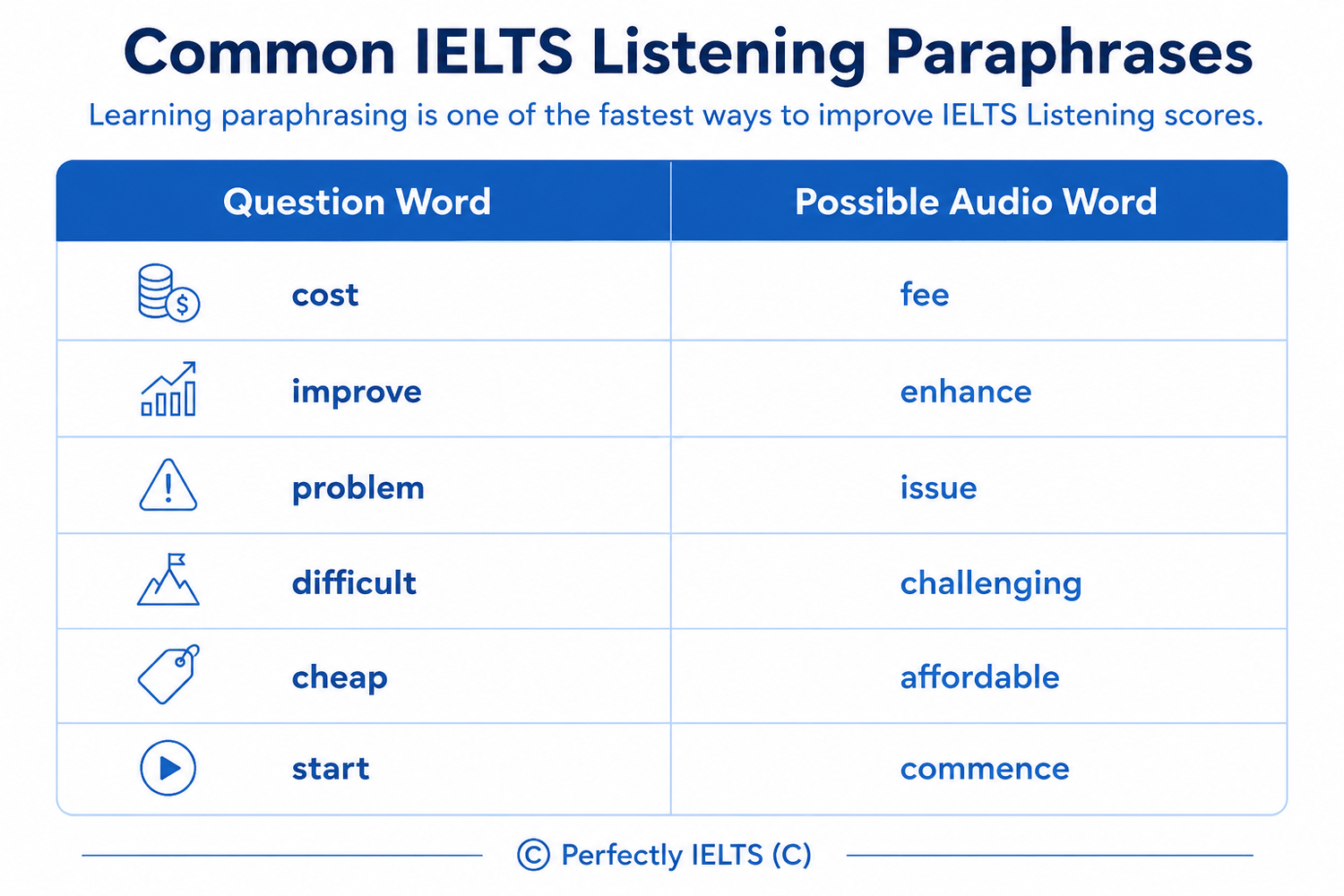
3. Ignoring Synonyms and Paraphrasing
IELTS rarely repeats the exact wording from the question paper.
Instead, the speaker usually paraphrases the information.
This is where many students struggle.
Example -
Question:
“What is the price of the course?”
Audio:
“The total fee is £300.”
The answer is still correct because:
price = fee
4. Making Spelling Mistakes
IELTS Listening is not only a listening test.
It’s also a spelling test.
If your answer is correct but spelled incorrectly, you lose the mark.
Commonly Misspelled IELTS Words
accommodation
environment
government
university
opportunity
schedule
How to Improve Spelling for IELTS
Daily Practice Ideas
write difficult words repeatedly
keep a vocabulary notebook
practice dictation exercises
review common IELTS vocabulary
Small spelling improvements can increase your score surprisingly quickly.
5. Forgetting the Word Limit
This is one of the easiest mistakes to avoid.
Yet thousands of students lose marks because they ignore instructions.
Example -
If the question says:
“NO MORE THAN TWO WORDS”
Then:
“library” ✅
“the library” ✅
“next to the library” ❌
Always check:
maximum words
singular/plural form
numbers allowed
hyphenated words
Reading instructions carefully can instantly save several marks.
6. Not Practicing Different English Accents
Many IELTS students only practice with American English or only British English.
But the IELTS Listening exam includes several accents, including: British, Australian, Canadian, New Zealand and American.
If you only train your ears for one accent, the real exam may feel much harder.
Best Resources for Accent Practice
British English
BBC podcasts
BBC News
Australian English
ABC Australia
Australian YouTube interviews
American English
TED Talks
NPR podcasts
The more accents you hear, the more confident you become during the exam.
7. Failing to Predict the Answer Type
Prediction is one of the most powerful IELTS Listening techniques.
Before the recording begins, ask yourself:
Will the answer be a number?
A place?
A noun?
A person’s name?
A date?
Your brain processes information faster when it expects certain answer types.
Example -
Question:
“The museum is located on ____ Street.”
You know the answer is probably:
a street name
a proper noun
Prediction improves both speed and accuracy.
8. Practicing IELTS Listening the Wrong Way
Many students think improvement comes from completing endless practice tests.
But simply doing more tests does not guarantee progress.
The Real Problem
Students often:
check answers quickly
move to another test
repeat mistakes again and again
Better IELTS Listening Practice Method
After every practice session:
review every mistake carefully
identify why you got it wrong
replay difficult sections
study paraphrasing
write down new vocabulary
Reviewing mistakes is where real improvement happens.
9. Poor Concentration During the Test
IELTS Listening requires intense focus for around 30 minutes.
Even a short loss of concentration can cost multiple answers.
Common Concentration Problems
Students often:
think about previous questions
panic after difficult sections
become distracted by unfamiliar words
lose focus near the end of the test
How to Improve Listening Focus
Simple Methods
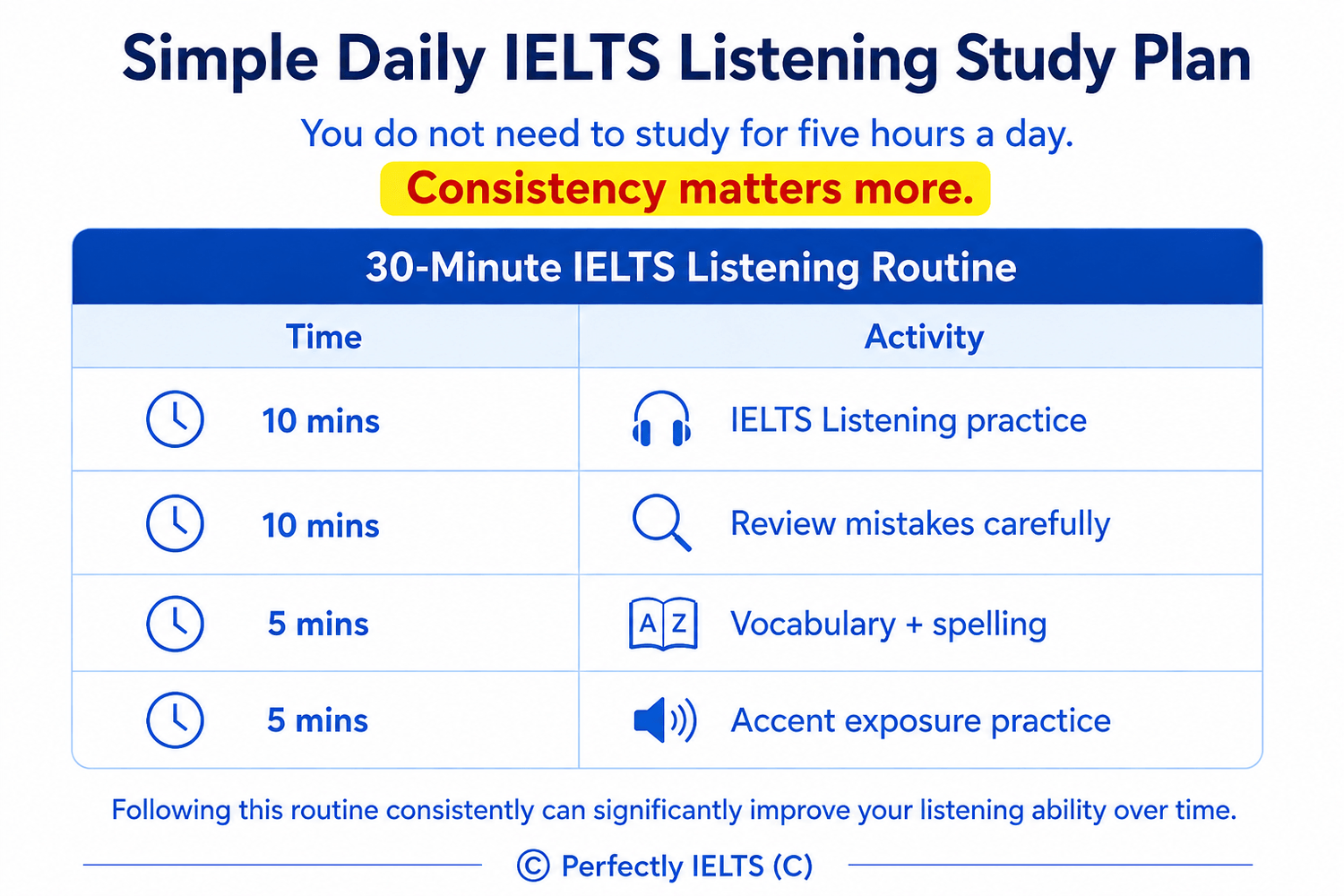
practice listening daily
avoid multitasking
train with full-length IELTS tests
sleep properly before the exam
practice under timed conditions
Mental endurance matters more than many students realize.
Best IELTS Listening Tips for Band 7+
Here are some of the most effective IELTS Listening strategies successful students use:
Before Listening
Read questions quickly
Underline keywords
Predict answer types
Prepare mentally
During Listening
Stay calm
Follow the speaker carefully
Watch for paraphrasing
Move on quickly if you miss an answer
After Listening
Check spelling
Review grammar
Confirm word limits
Ensure answers fit logically
Small habits create big score improvements.
Free 5-Day IELTS Course
If you want a structured way to improve your IELTS score faster, we've created a free 5-day IELTS course designed to help students:
improve Listening, Reading, Writing, and Speaking
avoid common IELTS mistakes
build effective study routines
understand Band 7+ strategies
prepare smarter for the real exam
👉 https://www.perfectly-ielts.com/5-day-free
This free course is perfect for students who want practical IELTS strategies without wasting time on ineffective study methods.
Frequently Asked Questions About IELTS Listening
Is IELTS Listening difficult?
IELTS Listening can feel difficult because it tests multiple skills simultaneously, including concentration, spelling, vocabulary, and paraphrasing recognition.
How can I improve IELTS Listening fast?
The fastest way to improve IELTS Listening is to:
practice consistently
review mistakes carefully
improve vocabulary
train with different English accents
learn IELTS exam strategies
How many mistakes can I make for Band 7 in IELTS Listening?
Typically, Band 7 in IELTS Listening requires around 30 correct answers out of 40, although score conversion may vary slightly.
Which accent is used in IELTS Listening?
IELTS Listening includes a mix of British, Australian, American, Canadian, and New Zealand accents.
Final Thoughts
Most students do not fail IELTS Listening because they are bad at English.
They fail because they:
panic
lose concentration
ignore instructions
misunderstand paraphrasing
practice inefficiently
The good news is that these problems are fixable.
With smart preparation, consistent practice, and the right strategies, improving your IELTS Listening score becomes much more achievable.
Focus on:
accuracy
concentration
paraphrasing
spelling
exam technique
And over time, your confidence and band score will improve naturally.

© Perfectly IELTS - Privacy Policy & Terms and Conditions