
IELTS General Writing Task 1 Band 7 Phrases (2026): Formal & Informal Letter Vocabulary That Scores Higher
IELTS General Writing Task 1 Band 7 Phrases (2026): Formal & Informal Letter Vocabulary That Scores Higher
Introduction
If you want to achieve a Band 7 or higher in IELTS General Writing Task 1, using the right phrases and sentence structures is essential. Many IELTS candidates lose marks because their letters sound too basic, repetitive, or inappropriate for the type of letter they are writing.
In this guide, you will learn powerful IELTS General Writing Task 1 Band 7 phrases for formal, semi-formal, and informal letters. These useful expressions will help you improve your vocabulary, coherence, and task achievement while making your writing sound more natural and professional.
For a full step-by-step IELTS Writing system, read our complete IELTS Writing Band 7+ Guide.
Why Phrases Matter in IELTS General Writing Task 1
Using strong phrases can help you:
Write more naturally and fluently
Improve your lexical resource score
Organize ideas clearly
Sound more formal or informal when needed
Avoid repeating simple vocabulary
However, remember that you should use phrases naturally. Memorizing too many expressions without understanding them can make your writing sound unnatural.
Types of IELTS General Writing Task 1 Letters
In IELTS General Training Writing Task 1, you may need to write:
Formal letters
Semi-formal letters
Informal letters
Each type requires different language and tone.
Formal Letter Phrases for IELTS General Writing Task 1
Formal letters are usually written to:
companies
managers
organizations
landlords
customer service departments
These letters should sound polite and professional.
Opening Phrases for Formal Letters
Use these phrases to begin your letter:
I am writing to express my concern regarding...
I am writing in connection with...
I am writing to inquire about...
I would like to draw your attention to...
I am writing to request further information about...
Example:
I am writing to express my dissatisfaction with the service provided by your company.
Request Phrases for Formal Letters
I would appreciate it if you could...
Could you please provide...
I would be grateful if you could...
I kindly request that you...
I would appreciate your prompt response.
Example:
I would appreciate it if you could send me the updated schedule at your earliest convenience.
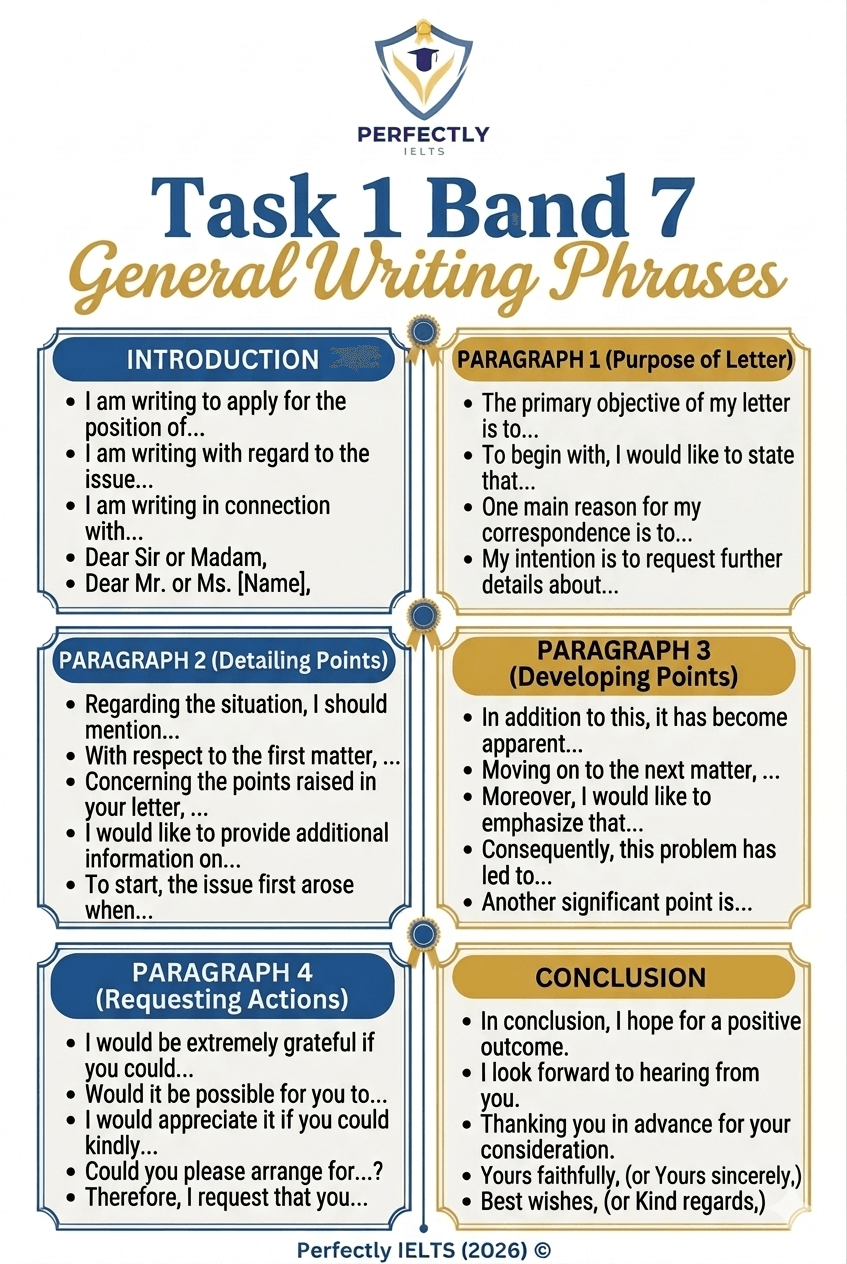
Here are some more examples in the image below:
Complaint Letter Phrases
I am dissatisfied with...
Unfortunately, the product/service did not meet my expectations.
I would like to make a complaint regarding...
The issue has caused significant inconvenience.
I expect this matter to be resolved promptly.
Example:
Unfortunately, the accommodation was not as advertised on your website.
Closing Phrases for Formal Letters
I look forward to hearing from you.
Thank you for your time and consideration.
I hope this issue can be resolved soon.
Please do not hesitate to contact me.
I look forward to your prompt response.
Formal Sign-Offs
Yours faithfully,
Yours sincerely,
Semi-Formal Letter Phrases
Semi-formal letters are usually written to someone you know professionally, such as:
a teacher
a colleague
a neighbour
a supervisor
The tone should be polite but slightly more relaxed.
Opening Phrases
I hope you are doing well.
I am writing regarding...
I wanted to let you know that...
I am writing to ask for your assistance.
Example:
I hope you are doing well. I am writing regarding the meeting scheduled for next week.
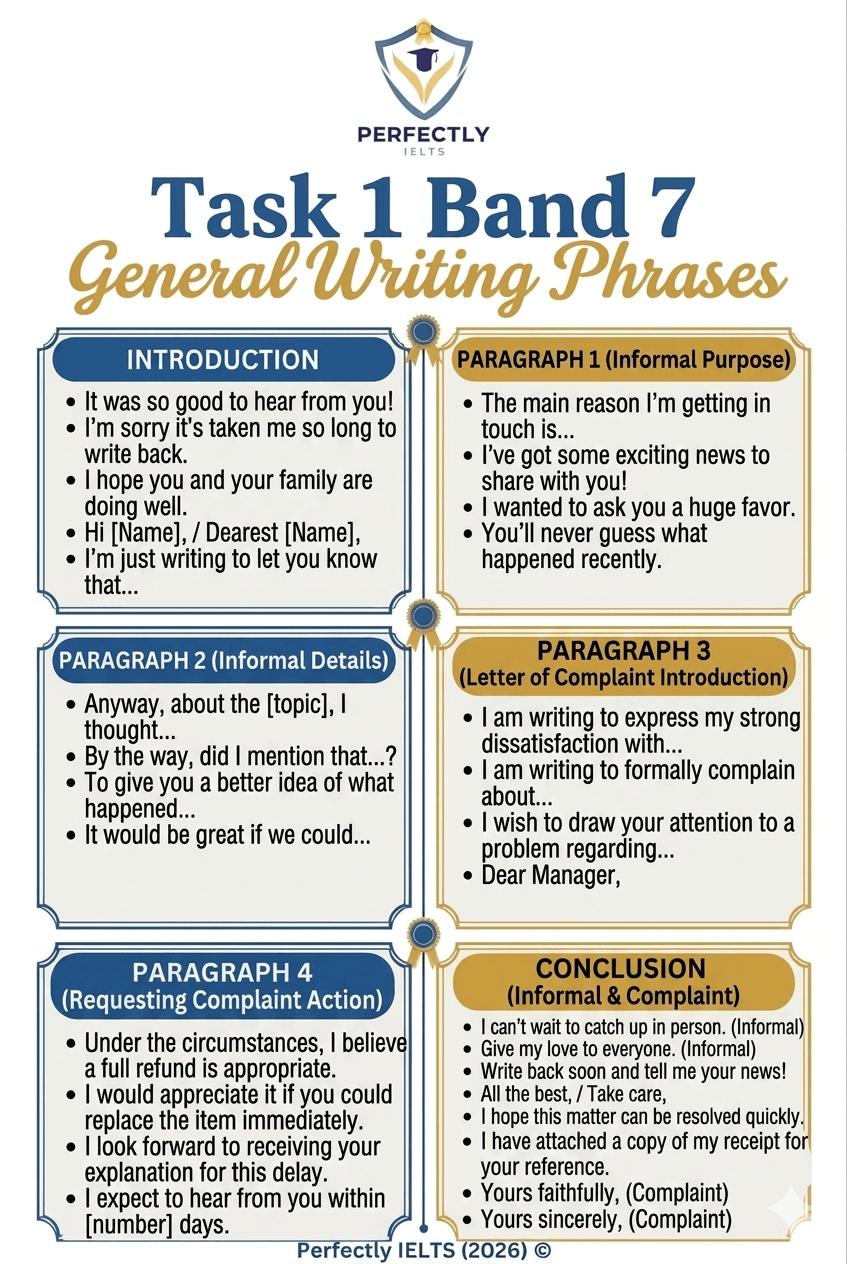
Helpful Phrases for Requests
Would it be possible for you to...?
I was wondering if you could...
I would really appreciate your help with...
Please let me know if this would be possible.
Example:
I was wondering if you could help me prepare for the upcoming presentation.
Closing Phrases
Thank you for your support.
I look forward to your reply.
Please let me know your thoughts.
I appreciate your assistance.
Semi-Formal Sign-Offs
Best regards,
Kind regards,
Informal Letter Phrases for IELTS General Writing Task 1
Informal letters are written to:
friends
family members
close acquaintances
These letters should sound warm, friendly, and natural.
Opening Phrases for Informal Letters
Hope you're doing great!
It’s been a while since we last spoke.
I was so happy to hear from you.
Thanks for your last letter.
How have you been?
Example:
It’s been a while since we last spoke, so I thought I’d write to catch up.
Invitation and Suggestion Phrases
Why don’t you...?
You should definitely...
It would be great if you could...
Let’s plan to...
How about...?
Example:
Why don’t you come stay with us during the holidays?
Friendly Closing Phrases
Can’t wait to hear from you!
Take care and stay in touch.
Hope to see you soon.
Give my regards to your family.
Informal Sign-Offs
Best,
Take care,
Lots of love,
Common Mistakes to Avoid
Many IELTS students lose marks because of these mistakes:
Using informal language in formal letters
Avoid:
Hey there!
Instead use:
Dear Sir or Madam,
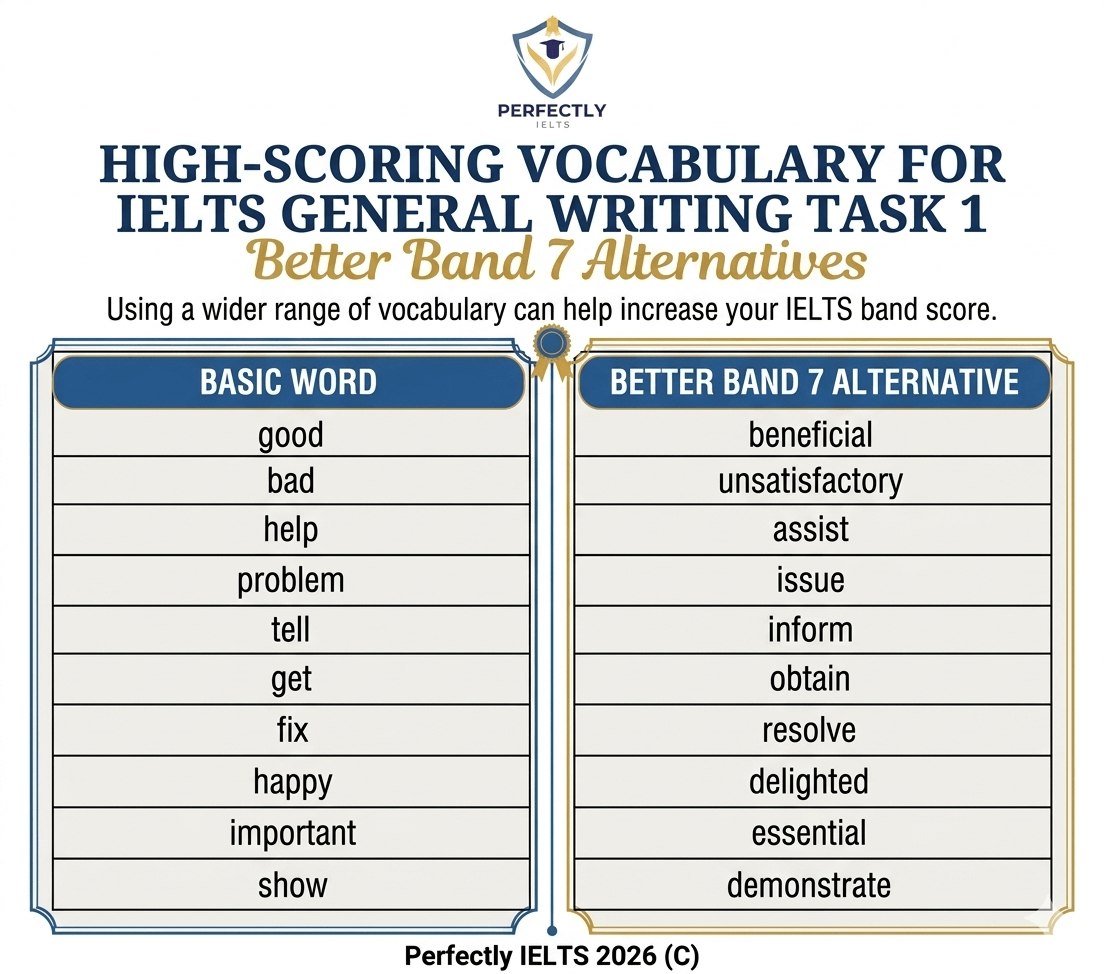
Repeating simple vocabulary
Avoid repeating words like:
good
bad
nice
thing
Use stronger alternatives instead. Like the ones given in the table above.
Forgetting the purpose of the letter
Always answer all bullet points from the task prompt.
Using memorized phrases unnaturally
Use phrases naturally and appropriately.
Sample Band 7 Opening and Closing Example
Question:
Write a letter to a hotel manager to complain about your recent stay.
Sample Opening:
Dear Sir or Madam,
I am writing to express my dissatisfaction with my recent stay at your hotel last weekend.
Sample Closing:
I hope this matter can be resolved promptly, and I look forward to hearing from you soon.
Yours faithfully,
John Smith
Final Tips to Get Band 7+ in IELTS General Writing Task 1
To improve your IELTS General Writing score:
Learn phrases for different letter types
Practice writing regularly
Focus on tone and formality
Use varied vocabulary naturally
Review Band 7 sample answers
Check grammar and spelling carefully
Consistency is key. The more letters you practice, the more confident and fluent your writing will become.
Conclusion
Mastering IELTS General Writing Task 1 Band 7 phrases can significantly improve your writing performance. By learning useful vocabulary, sentence structures, and appropriate expressions for formal, semi-formal, and informal letters, you will be better prepared to achieve a higher IELTS score.
Make sure to practice these phrases regularly and apply them naturally in your writing tasks.
If you want to improve even faster, explore our IELTS study plans and start your course immediately. You’ll also have the option to get your IELTS writing professionally assessed with personalised feedback to help you reach Band 7+ faster.
Start here: 👉 www.perfectly-ielts.com

© Perfectly IELTS - Privacy Policy & Terms and Conditions